
Software isn't finished when it launches
It gets used, and then it needs looking after. Here is exactly what that means, what it costs you in attention, and where the edges of it are — including the hours I am not available, which is the part most people find out the hard way.
I know before you do
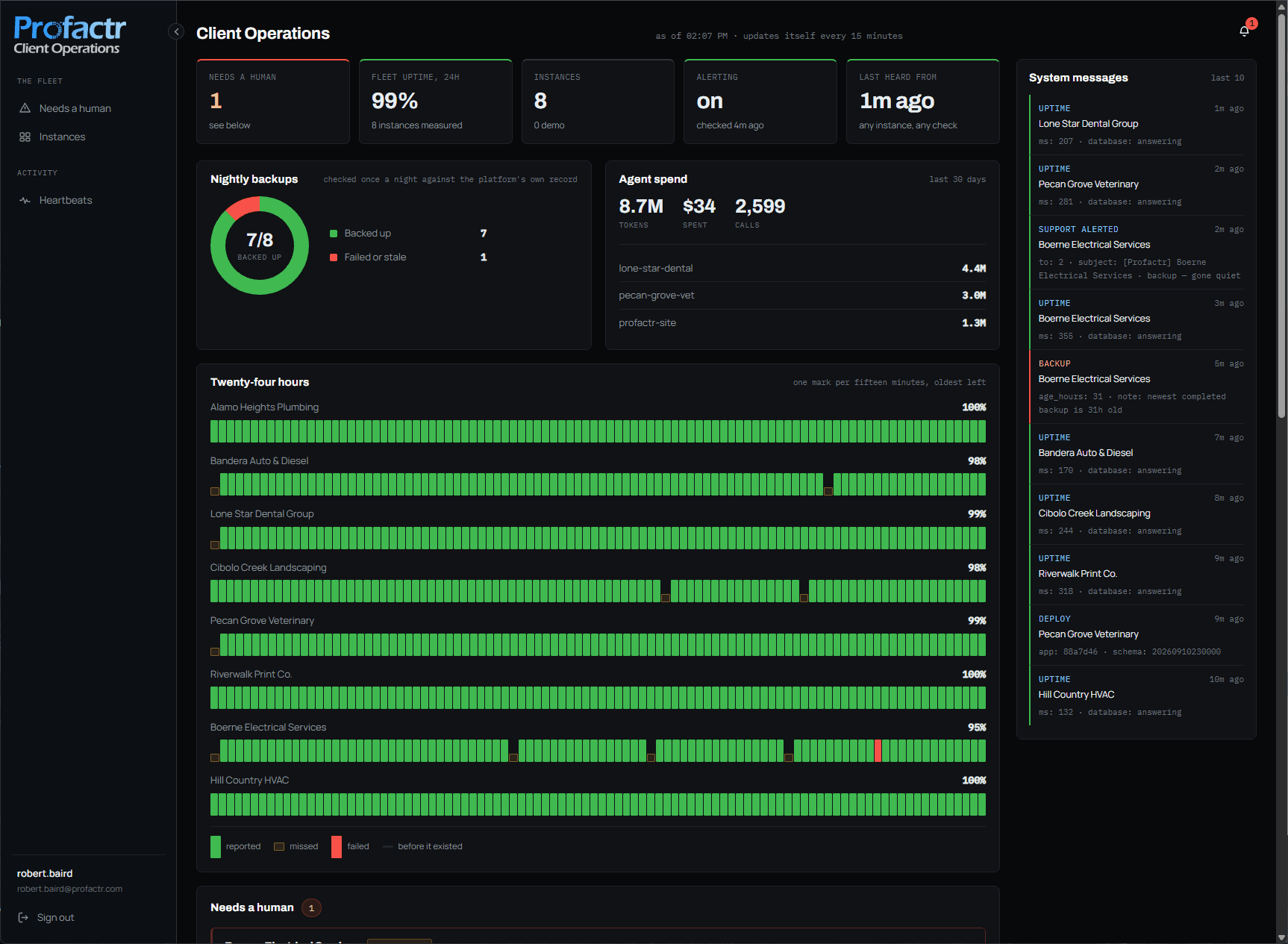
Every system I have delivered reports into one board — whether it is up, what is erroring, how long things are taking, and whether last night's backup actually saved rather than just saying it did. It is the first thing I open in the morning and the alerts come to my phone, not to a screen nobody is watching.
So the ordinary case is that something gets found and fixed before anybody at your business has noticed there was anything to find. When it is something you do need to know about, you hear it from me rather than from a customer.
One person, one board — not a room full of screens. What that buys you is that nothing waits in a queue behind somebody else's ticket.
What else being looked after covers
It stays up, and stays patched
Hosting, security updates, and the version upgrades underneath that nobody asks for and everybody needs. You will not get a call from me about a library going out of date.
Backups you could actually restore from
Nightly, kept off the machine they came from, and tested — a backup nobody has restored is a hope, not a backup.
A note each month
A short one, saying what changed and what I did. The fee is easy to forget about when nothing is on fire, and that note is so you can see what it bought.
Small changes as you go
The wording on a form, a field you wish you had, a report that would be more useful the other way round. About an hour of these a month is included, and they go out together in one release rather than one at a time. What counts is spelled out further down rather than left to a conversation in month four.
And what it doesn't
Said here rather than discovered in month three. If any of this is a problem, it is much cheaper for both of us to know now.
There is no emergency line
The agent answers around the clock. I do not. If your business genuinely needs somebody reachable at 2am, say so at the first conversation and I will tell you honestly that this is the wrong shape for you.
One person, not a queue
You email or text me and I answer. There is no ticket number, no account manager, and nobody who has to go and ask somebody else what happened. That is the trade: slower than a call centre at 9pm, faster than one at any other time.
Holidays happen
I take them, and I tell you before I go. Monitoring keeps running and anything genuinely broken gets picked up — but a small change asked for on the Friday I leave will wait.
If an hour a month is not enough
More of my time · $199 a monthSome businesses change faster than others. If yours is one of them, you can have two hours of changes a month instead of about one, going out when they are ready rather than waiting for the monthly release, and acknowledged the same working day rather than the next.
It is more of my time, not a place further up a queue — there is no queue to be further up. Nobody else's work goes slower because you bought this.
What a change hour covers
- Wording anywhere — a label on a form, a button, the text of an email or a reminder that goes out.
- A field added to a form you already have, taken off one, or moved somewhere more sensible.
- A column added to a report, or the same report sorted the way you actually read it.
- Prices, tax rates, service lists — the numbers you charge, when they change.
- Who sees what. A new person on the team, or somebody who should not be seeing costs.
- A status renamed to whatever you call it out loud, or a new one added to a job or a quote.
- A notification going to the wrong person, at the wrong time, or too often.
- Your logo, your photos, your terms on a document.
What gets a price first
- A component you do not have yet — booking, an online store, inventory.
- A screen that does not exist, or a new kind of record to keep.
- Connecting to somebody else's system.
- Another pile of history to bring across.
- Anything that changes how money moves.
Nothing here is a stopwatch. If something takes twenty minutes I am not going to bill you for it or tell you that you have used your hour — the point of the number is that we both know roughly where the line is, not that either of us is counting.
In plain terms: I answer during business hours, Central time, and get back to you the next working day at the latest.
Which of these includes it
The one people are surprised by: buying a build outright does not come with somebody looking after it. You own the code, so that choice is yours to make.
| How you bought it | Support | What that means |
|---|---|---|
| The shop system | Included | Support is not an add-on here, it is part of what the monthly pays for. The software is the part you can see. |
| AI agents | Included | Same arrangement. An agent that nobody keeps trained on your business stops being right about it within a month. |
| A build you own | Not automatic | You own the code, so you can maintain it yourself or hire whoever you like. If you would rather I did, that is the care plan — month to month, cancel any time. |
| Care plan | This is it | Everything on this page, on software I built for you or in some cases software somebody else did. Ask and I will tell you whether I can take it on. |
| Scope & Plan, Architecture Review | Nothing to support | The deliverable is a written document and it is yours. There is no system to keep running afterwards. |
Already working together and something is wrong? Email me at robert.baird@profactr.com — that is the whole process.
Want this on something you already have?
I take on other people's software sometimes, if I can read it and it isn't held together with something I'd have to rebuild first. Tell me what you're running and I'll say honestly whether I can look after it.